Category: Nutrition & Recovery

Food, hydration, sleep and recovery.

  • You Can Work Hard All Day… And Still Gain Weight

    You Can Work Hard All Day… And Still Gain Weight

    “I work ten hours a day… how am I still putting weight on?”

    It’s a question I’ve heard on construction sites for years.

    If you’re a machine operator, you leave home early, work long shifts and get home exhausted. So why does your waistline keep growing?

    The answer isn’t because you’re lazy.

    It’s because working hard and being physically active aren’t always the same thing.

    If you’ve worked in construction long enough, you’ve probably heard someone say it.

    “I’m working harder than I’ve ever worked… but I’m still putting weight on.”

    At first, it doesn’t make sense.

    You leave home before most people are awake.

    You battle through traffic.

    You spend ten hours on site.

    You get home physically and mentally drained.

    Then one day your trousers feel tighter.

    Your belt moves out another notch.

    You look in the mirror and wonder…

    “How can I be working this hard and still be getting fatter?”

    After spending over forty years in construction, I’ve heard that conversation more times than I can count.

    The problem is…

    Most people assume working hard automatically means being physically active.

    They’re not the same thing.

    Construction Isn’t One Job

    One of the biggest mistakes people make is thinking everyone in construction has the same physical workload.

    They don’t.

    A groundworker on the shovel…

    A hod carrier…

    A bricklayer…

    An excavator operator…

    A tower crane driver…

    All work in construction.

    But their bodies experience completely different demands.

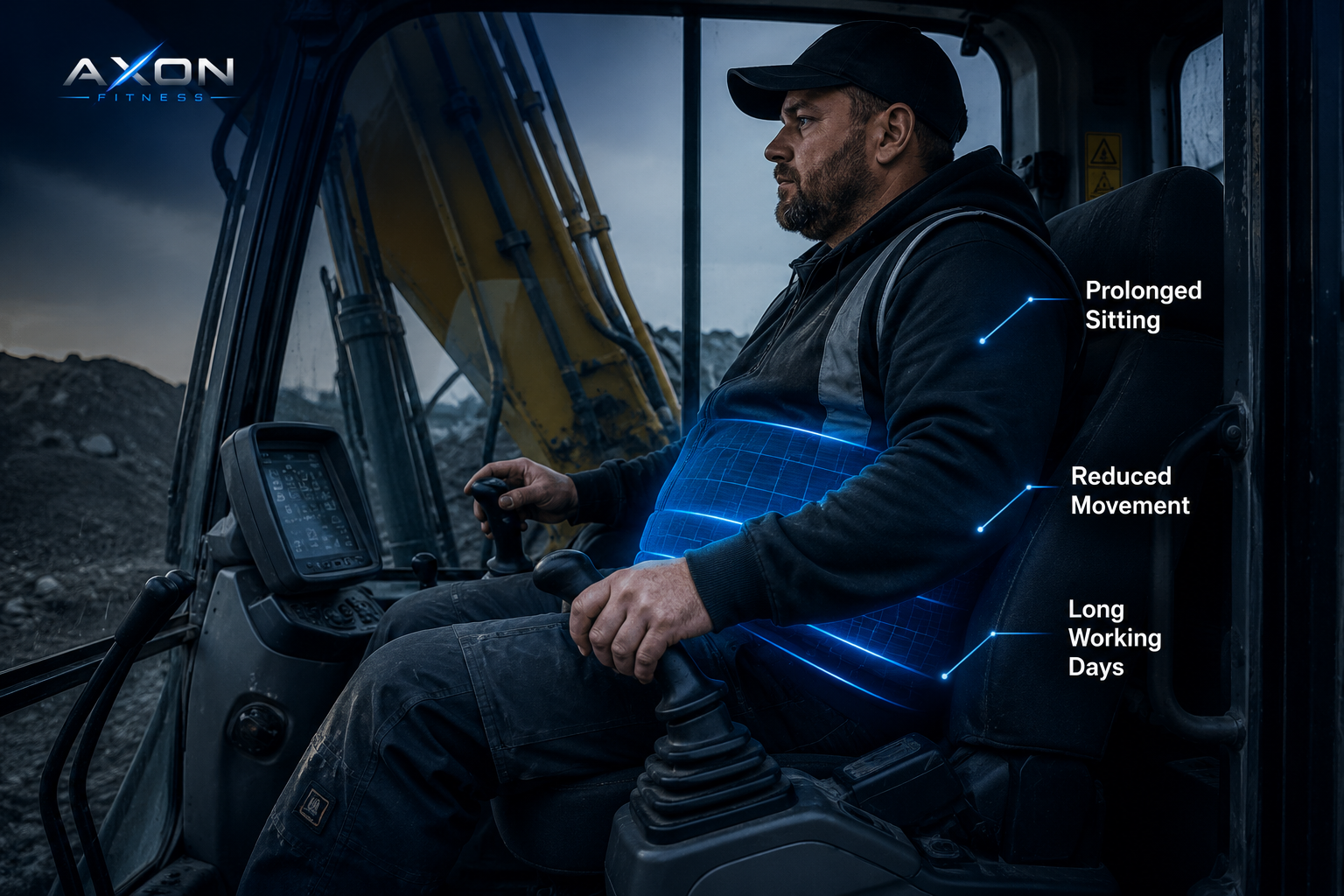
    If you’re operating an excavator, loading shovel, dozer or telehandler, you may spend eight to ten hours sitting in one position.

    You’re concentrating.

    You’re operating controls.

    You’re dealing with vibration.

    You’re making constant decisions.

    You’re tired.

    But you may not actually be moving very much.

    That’s a very different type of fatigue.

    Tired Doesn’t Always Mean Active

    This is one of the biggest myths I hear.

    “I’m shattered, so I must have burned loads of calories.”

    Not necessarily.

    You can be physically exhausted…

    Without being physically active.

    Driving machinery demands concentration.

    Your nervous system is constantly working.

    Your muscles stay switched on to stabilise your body.

    You’re exposed to vibration.

    You’re sitting in restricted positions for hours.

    By the end of the shift, you’re genuinely tired.

    But tired and active aren’t the same thing.

    This is one of the reasons I wrote Why Working Hard Isn’t the Same as Staying Fit, because they’re two completely different things.

    Read more: Why Working Hard Isn’t the Same as Staying Fit

    The Job Doesn’t Finish at 4:30

    The shift ends.

    The day doesn’t.

    Now comes the drive home.

    More sitting.

    More traffic.

    You finally walk through the front door.

    You’re exhausted.

    The last thing you feel like doing is cooking from scratch or going to the gym.

    So what happens?

    You grab whatever’s quickest.

    Sit down.

    Recover.

    Then tomorrow…

    You do it all again.

    Week after week.

    Month after month.

    Year after year.

    That’s how weight slowly creeps on.

    Not because you’ve suddenly become lazy.

    Because the environment makes it incredibly easy to move less than you realise.

    Sitting Changes More Than Your Waistline

    Long periods of sitting don’t just affect body weight.

    They can contribute to:

    • Stiff hips.
    • Tight hamstrings.
    • Reduced calorie expenditure.
    • Poor circulation.
    • Aching lower backs.
    • Reduced insulin sensitivity.
    • Lower overall daily movement.

    If you’ve already read Why Your Legs Feel Heavy After a Day in the Cab, you’ll know how sitting also affects blood flow and why small movement breaks matter.

    Read more: Why Your Legs Feel Heavy and Swollen After a Day in the Cab

    Research also shows that prolonged sedentary behaviour is associated with poorer metabolic health and an increased risk of weight gain, even in people who meet some exercise recommendations.

    External Reference:
    https://www.nhs.uk/live-well/exercise/why-sitting-too-much-is-bad-for-us/

    Don’t Rely on the Job to Keep You Fit

    This is probably the biggest lesson I’ve learnt.

    Construction pays the bills.

    It doesn’t automatically protect your health.

    Your employer pays you to do a job.

    Your machine is there to move earth.

    Neither one is responsible for keeping your body healthy.

    That’s your responsibility.

    It isn’t always easy.

    But it is possible.

    So What Can You Do?

    Forget perfection.

    Forget trying to train like someone who’s been sitting behind a desk all day.

    Your life is different.

    Start with realistic habits.

    Try to:

    • Strength train two or three times each week.
    • Prioritise protein at each meal.
    • Walk for ten minutes after your evening meal whenever possible.
    • Get out of the cab during safe breaks and move around.
    • Keep your bodyweight under control before small gains become large ones.

    Small changes repeated consistently are far more powerful than grand plans that only last two weeks.

    Challenge One Belief

    For the next week…

    Stop saying…

    “I work hard, so I must be burning loads of calories.”

    Instead ask yourself…

    “How much of my day am I actually moving?”

    Those are two completely different questions.

    How Axon Fitness Can Help

    Axon Fitness exists because I’ve lived the reality of construction.

    I’ve worked through freezing winters.

    I’ve worked through heatwaves.

    I’ve sat in traffic before and after long shifts.

    I’ve heard the same conversations on site for decades.

    “My back’s gone.”

    “I’m shattered.”

    “I’m putting weight on.”

    My job isn’t to pretend construction is easy.

    It’s to help you understand what it’s doing to your body and give you realistic ways to reduce the physical cost of earning a living.

    If you’re ready to start, download the Free Axon Fitness Driver Mobility Guide and take the first step towards feeling better on and off site.

    Free Guide:
    Free Axon Fitness Driver Mobility Guide

    Final Thoughts

    Construction is hard.

    Sometimes it’s freezing.

    Sometimes it’s thirty-three degrees.

    Sometimes you spend ten hours sitting in a machine.

    Sometimes you spend ten hours on your feet.

    Whatever your job…

    Don’t assume working hard automatically means you’re looking after your health.

    They’re not the same thing.

    The job already takes enough from you.

    Don’t let it quietly take your health as well.

    Disclaimer

    This article is for educational purposes only and should not replace personalised medical advice. If you’re concerned about your weight, health or any ongoing symptoms, speak to your GP or another qualified
  • Seated Calf Pumps for Drivers: How They Can Help Blood Flow After Eating

    Seated Calf Pumps for Drivers: How They Can Help Blood Flow After Eating

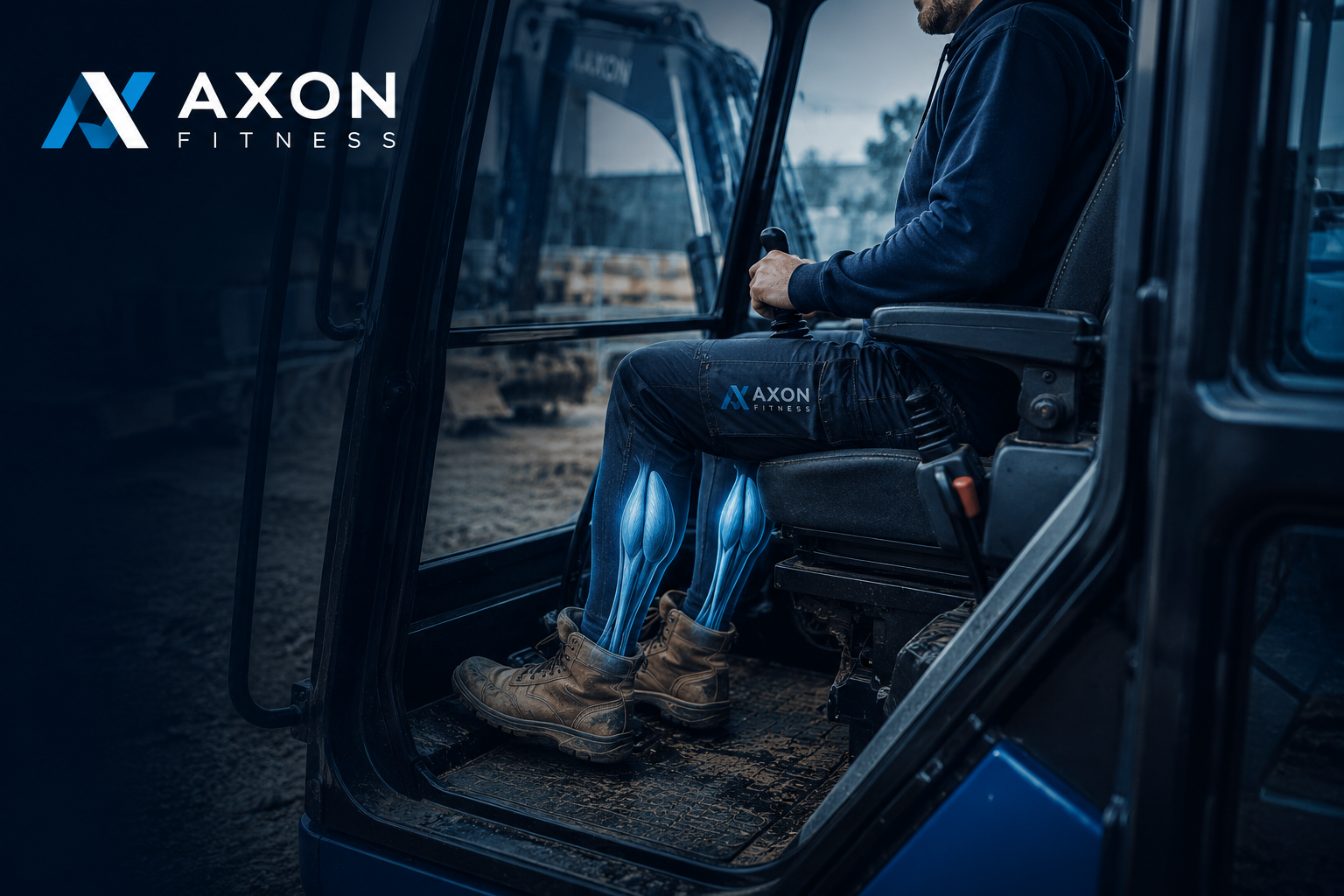
    If you spend most of your day sitting in a cab, your lower legs are not doing much.

    Your hips are bent.

    Your knees are bent.

    Your ankles barely move.

    Your calves are quiet.

    And if you have just eaten, your body is also dealing with digestion, blood flow and the normal rise in blood sugar that comes after a meal.

    This is where a simple seated calf pump can be useful.

    It is not a magic exercise.

    It is not a cure for diabetes.

    It will not replace walking, strength training, proper food choices or medical care.

    But for machine operators, truck drivers and anyone who spends long hours sitting, pumping the calves while seated can be a practical way to support blood flow through the legs and may help the body handle post-meal glucose better.

    Small movement still counts.

    Especially when the alternative is sitting completely still for hours.

    Why Sitting Still Is A Problem For Drivers

    When you are sitting for long periods, the muscles in your lower legs are not contracting much.

    That matters because your calf muscles help move blood back up from the lower legs towards the heart.

    The heart pumps blood out.

    But the legs need muscle contraction to help push blood back up.

    That is why the calves are often called a kind of “second pump” for the body.

    If you sit still for hours, especially in a cab, blood flow through the legs can become more sluggish.

    You may notice:

    • heavy legs
    • swollen ankles
    • tight calves
    • restless legs
    • cold feet
    • stiffness when climbing out
    • lower-leg ache after a long shift
    • feeling like your legs need a walk before they wake up

    This is not unusual for drivers and machine operators.

    The job itself limits movement.

    You are not walking around freely.

    You are sitting, concentrating, operating controls, watching the job and trying to stay comfortable in a position that was never designed for long-term health.

    The NHS advises not sitting still for long periods and getting up to move around regularly where possible. The British Heart Foundation also suggests small movements like wriggling the toes or rotating the ankles if you have been sitting for a long time.

    Useful external reading:

    NHS guidance on DVT and long periods sitting

    British Heart Foundation advice on circulation

    What Is A Seated Calf Pump?

    A seated calf pump is simple.

    You sit with your feet flat on the floor.

    Keep the front of the foot down.

    Lift your heels up.

    Squeeze the calves gently.

    Lower the heels back down.

    Repeat.

    It looks basic, but it gets the lower-leg muscles contracting.

    You can do it under a desk, in a break room, in a van when parked, at home after food, or during a break on site.

    For machine operators, the key point is this:

    Do not do anything that affects safe machine control.

    If your feet are needed for pedals, controls or safe operation, leave it alone until you are stopped, parked or on a proper break.

    Movement is useful.

    Safety comes first.

    Why The Soleus Muscle Matters

    The calf is not just one muscle.

    One of the key muscles is the soleus.

    The soleus sits deeper in the calf and is active during standing, walking and certain seated heel-raise movements.

    Research on the “soleus push-up” has attracted attention because it showed that targeted seated activation of the soleus could raise muscle metabolism for long periods and improve post-meal glucose and insulin responses under study conditions.

    You can read the research summary here:

    PubMed: Soleus oxidative metabolism and glucose regulation

    This does not mean every casual calf pump gives the same result as a controlled laboratory study.

    That matters.

    The study movement was specific.

    The technique was controlled.

    The results should not be turned into a social media claim that “calf raises fix blood sugar.”

    But the practical idea is still useful:

    Contracting muscles while seated is better than sitting completely still.

    And the lower legs are a simple place to start.

    How Calf Pumps May Help Blood Flow

    Every time you lift and lower the heels, the calf muscles contract and relax.

    That squeezing action can help support venous return, which is the movement of blood back from the legs towards the heart.

    This is one reason hospitals sometimes use calf or foot pumps for people who are sitting still or lying down. These devices provide pressure to increase blood flow out of the legs.

    Useful external reading:

    Guy’s and St Thomas’ NHS Foundation Trust: calf or foot pumps and blood flow

    For drivers, the everyday version is simple movement.

    Not medical equipment.

    Not treatment.

    Just using your own muscles so your legs are not completely switched off for hours.

    This is especially useful after long periods sitting, after eating, or before you climb out of the cab and expect your legs to work properly.

    What About Glucose After Eating?

    After you eat, especially after a meal containing carbohydrates, blood glucose naturally rises.

    That is normal.

    The body then uses insulin and muscle activity to help move glucose from the blood into tissues where it can be used or stored.

    Walking after meals is one of the simplest ways to help with this.

    But drivers and operators cannot always go for a walk straight after eating.

    You might be in the cab.

    You might be on site.

    You might be in the van.

    You might be waiting, watching, or parked up with limited space.

    That is where seated calf pumping may have a place.

    It is not as good as a proper walk.

    It is not a replacement for training.

    But it may give the body some muscular activity at a time when you would otherwise be completely still.

    For a driver who eats lunch and then sits straight back down for hours, that is worth thinking about.

    When To Use Calf Pumps

    Good times to use them include:

    • after meals when seated
    • during breaks
    • when parked safely
    • at home after dinner
    • during long periods at a desk
    • before driving home after a shift
    • after long commutes
    • when your legs feel heavy or stiff

    A simple starting point:

    Do 30–60 seconds of seated calf pumps.

    Rest.

    Repeat for 2–5 minutes.

    If you are sitting for a long stretch, repeat this every 20–30 minutes when possible.

    You do not need to hammer them.

    The aim is steady movement, not calf cramp.

    How To Do Them Properly

    Sit tall if possible.

    Keep both feet flat.

    Keep the balls of the feet on the floor.

    Lift the heels up.

    Pause briefly at the top.

    Lower the heels under control.

    Repeat smoothly.

    Avoid bouncing aggressively.

    Avoid forcing the movement if you have pain.

    If you feel cramp, back off.

    If you have an ankle injury, calf injury, circulation condition, diabetes complications, nerve symptoms, swelling or a history of blood clots, speak to a qualified health professional before relying on this as a strategy.

    Calf Pumps Are A Tool, Not The Whole Plan

    This is important.

    Seated calf pumps are useful, but they are not enough on their own.

    Drivers and machine operators still need:

    • regular walking where possible
    • good hydration
    • enough protein
    • strength training
    • hip mobility
    • glute strength
    • proper recovery
    • better movement outside work
    • sensible food choices

    The calf pump is a small tool.

    It helps break the pattern of sitting completely still.

    But the bigger goal is to build a body that can handle long hours sitting, driving, operating and working without slowly losing strength and mobility.

    If you struggle with heavy legs after long hours in the cab, this related Axon Fitness article may help:

    Why Your Legs Feel Heavy and Swollen After a Day in the Cab

    You may also find this useful:

    You Sit for 16 Hours a Day. Here’s What That’s Doing to Your Body

    A Simple Post-Meal Driver Routine

    If you have just eaten and you know you are about to sit again, try this:

    • 2 minutes easy walking if you can
    • 2 minutes seated calf pumps
    • 10 ankle circles each way
    • 10 gentle toe raises
    • drink some water
    • stand up again within the next hour if possible

    If you cannot walk, just use the seated movements.

    Something is better than sitting frozen.

    Small movements repeated daily can have a big effect over time because they interrupt the pattern that causes the problem.

    Free Download

    If long hours sitting are leaving your legs heavy, your hips tight or your back stiff, start with the free Axon Fitness mobility guide here:

    Free Axon Fitness Driver Mobility Guide

    It gives you five simple mobility fixes designed for machine operators and drivers, and it takes less than five minutes to use.

    How Axon Fitness Can Help

    Axon Fitness helps machine operators, plant drivers, truck drivers, tradespeople and adults over 40 stay strong, mobile and capable for the long term.

    The goal is not bodybuilding.

    The goal is practical strength, mobility, circulation, recovery and injury prevention built around real working life.

    If your job keeps you sitting for long hours and your body is starting to feel it, the Machine Operators page explains how Axon Fitness supports drivers with practical strength and mobility advice:

    Fitness for Machine Operators & Plant Drivers

    Disclaimer

    This article is for general education only and is not medical advice. If you have ongoing pain, numbness, swelling, chest symptoms, diabetes, circulation problems, or a medical condition, speak to a qualified health professional.

  • The Construction Industry’s Protein Problem

    The Construction Industry’s Protein Problem

    Most construction workers don’t think they have a nutrition problem.

    After all, they’re eating.

    Sometimes a lot.

    A bacon roll on the way to site.

    A meal deal at lunch.

    A few biscuits with a brew.

    Something quick when they get home.

    The issue isn’t always the amount of food being eaten.

    The issue is whether that food is helping the body recover from years of physical work.

    As we get older, that question becomes increasingly important.

    Eating Plenty Doesn’t Mean Eating Well

    One of the biggest misconceptions in construction is:

    “I work hard, so I can eat whatever I like.”

    To a point, that’s true.

    Physical work burns calories.

    But recovery requires more than calories.

    It requires nutrients.

    And one of the most important nutrients for maintaining strength and physical capability is protein.

    Why This Matters More After 40

    As we age, we naturally begin to lose muscle mass.

    This process starts earlier than many people realise.

    Research has shown that age-related muscle loss can begin long before retirement age.

    If you’re interested in staying capable as you get older, you may also find this article useful:

    How to Get Fit After 40

    The goal isn’t becoming a bodybuilder.

    The goal is maintaining enough strength and muscle to keep doing the things you want to do.

    Working Hard Doesn’t Protect You

    Many workers assume that because their job is physical, muscle loss won’t affect them.

    Unfortunately, that’s not always true.

    I’ve written before about how physical work and fitness aren’t necessarily the same thing.

    Why Working Hard Isn’t the Same as Staying Fit

    Physical work places demands on the body.

    But it doesn’t automatically provide the strength training stimulus needed to maintain muscle long-term.

    Nor does it guarantee you’re eating in a way that supports recovery.

    The Typical Site Diet

    Walk onto most sites and you’ll see some familiar choices.

    • Bacon rolls
    • Sausage sandwiches
    • Crisps
    • Chocolate bars
    • Energy drinks
    • Meal deals
    • Convenience foods

    None of these foods are automatically bad.

    The issue is when they become the foundation of your daily nutrition.

    Many workers are consuming plenty of calories while still missing out on nutrients that support recovery and muscle maintenance.

    Recovery Starts Long Before The Gym

    Most people think recovery is something athletes worry about.

    But if you’re:

    • Operating machinery
    • Carrying materials
    • Working long shifts
    • Driving long distances
    • Spending years on site

    Then recovery matters to you as well.

    Recovery isn’t just about feeling less tired.

    It’s about maintaining the physical capacity to keep doing your job and enjoying life outside work.

    The Link Between Protein And Recovery

    Protein provides the building blocks your body uses to repair and maintain tissue.

    This becomes increasingly important as we get older.

    Research has consistently shown that adequate protein intake supports muscle maintenance and healthy ageing.

    Research:

    https://pmc.ncbi.nlm.nih.gov/articles/PMC6566799/

    The exact amount varies from person to person.

    Age.

    Body weight.

    Activity levels.

    Goals.

    All matter.

    That’s why individual recommendations are often more useful than generic formulas.

    The Goal Isn’t Bigger Muscles

    This is where many people switch off.

    They hear the word protein and immediately think:

    “That’s for gym lads.”

    The reality is very different.

    For most machine operators and tradesmen, the goal isn’t bigger muscles.

    The goal is:

    • Staying strong.
    • Staying mobile.
    • Recovering better.
    • Remaining independent.
    • Continuing to do the things you enjoy.

    Protein is simply one piece of that bigger picture.

    Why Machine Operators Need To Pay Attention

    Machine operators face a unique challenge.

    Long periods sitting in the cab often mean lower levels of physical activity than many people assume.

    At the same time, operators still need:

    • Strength
    • Stability
    • Concentration
    • Recovery

    This is one reason I recently wrote:

    Why Every Machine Operator Over 40 Should Know About Creatine

    Supporting muscle and recovery becomes increasingly important as the years go by.

    Small Changes Make A Big Difference

    Most people don’t need a perfect diet.

    They don’t need to weigh every gram of food.

    They don’t need to live on protein shakes.

    What they often need is greater awareness of how their food choices affect:

    • Recovery
    • Energy
    • Strength
    • Long-term health

    Small improvements performed consistently tend to outperform short bursts of perfection.

    Final Thoughts

    The construction industry doesn’t have a calorie problem.

    It often has a recovery problem.

    Many workers are eating enough food to get through the day.

    But not necessarily eating in a way that supports long-term physical capability.

    As we get older, maintaining strength becomes less about working harder and more about recovering smarter.

    Protein is only one part of the equation.

    But it’s an important part that many workers overlook.

    Frequently Asked Questions

    Why does protein become more important with age?

    As we get older, maintaining muscle mass becomes increasingly important for strength, mobility and independence.

    Is protein only important if I go to the gym?

    No. Protein supports the maintenance and repair of body tissues regardless of whether you train.

    Can physical work replace strength training?

    Physical work provides activity, but it doesn’t always provide the same benefits as structured strength training.

    Do machine operators need protein?

    Like everyone else, machine operators need adequate nutrition to support recovery, health and physical capability.

    Is eating more food the same as eating better?

    Not necessarily. The quality and balance of your nutrition matters as much as the quantity.

    About the Author

    Stewart Axon is the founder of Axon Fitness. With more than 40 years of experience in construction, machine operating and physical trades, he understands first-hand the wear and tear that demanding work places on the body. Through Axon Fitness, he helps machine operators, tradesmen and adults over 40 stay strong, mobile and capable for the long haul.

  • Why Energy Drinks Are Wrecking Your Afternoon

    Why Energy Drinks Are Wrecking Your Afternoon

    It’s 5am.

    The alarm goes off.

    You’ve got a long commute ahead of you, a full shift on site and another busy day in the cab.

    So you reach for an energy drink.

    Or a strong coffee.

    Or both.

    The caffeine kicks in.

    You feel more awake.

    More alert.

    More ready for the day.

    The problem is that what helps at 5am may be causing problems at 3pm.

    And even bigger problems at 10pm.

    The Caffeine Rollercoaster

    Most people use caffeine because they’re tired.

    That’s understandable.

    Machine operators and tradesmen often work long hours, start early and spend much of the day concentrating.

    The issue isn’t necessarily caffeine itself.

    The issue is often the amount and timing.

    Caffeine blocks adenosine, a chemical involved in promoting sleep and tiredness.

    For a while, this can make you feel more alert.

    But eventually the caffeine wears off.

    And when it does, the fatigue that was temporarily hidden often returns.

    Sometimes even stronger than before.

    The result is another coffee.

    Another energy drink.

    And another cycle of stimulation.

    Why The Afternoon Crash Happens

    Many workers describe the same pattern.

    • Energy drink before work.
    • Coffee at break.
    • Another caffeine hit after lunch.
    • Energy crash by mid-afternoon.

    The body hasn’t suddenly run out of energy.

    In many cases, you’re simply experiencing the ups and downs of stimulant use combined with normal fatigue.

    This can be particularly noticeable after poor sleep.

    The Hidden Cost: Your Sleep

    This is where things become important.

    Many people think caffeine only affects them if it stops them falling asleep.

    But that’s only part of the story.

    Research has shown that caffeine consumed even six hours before bedtime can reduce sleep duration and negatively affect sleep quality.

    Research:

    https://jcsm.aasm.org/doi/10.5664/jcsm.3170

    The half-life of caffeine is roughly five to six hours for many adults.

    That means a large coffee or energy drink consumed in the afternoon may still be affecting your body late into the evening.

    Even if you fall asleep easily, sleep quality may be reduced.

    Why Deep Sleep Matters

    Deep sleep is where much of your recovery takes place.

    During deep sleep, your body is involved in:

    • Physical recovery
    • Muscle repair
    • Hormone regulation
    • Memory consolidation
    • Cognitive recovery

    Machine operators often focus on staying awake.

    But recovery happens when you’re asleep.

    Poor sleep doesn’t just make you tired.

    It may affect:

    • Training progress
    • Physical recovery from work
    • Concentration
    • Decision-making
    • Mood
    • Long-term health

    This is one reason why recovery deserves as much attention as training.

    You Can’t Out-Train Poor Sleep

    Many people try to fix fatigue with more caffeine.

    The problem is that poor sleep often creates the fatigue in the first place.

    Then more caffeine affects sleep.

    Which creates more fatigue.

    Which leads to more caffeine.

    It’s a cycle that’s easy to get stuck in.

    What Changed When I Reduced My Caffeine Intake

    For years I relied heavily on caffeine.

    At one point I was drinking around five latte sachets a day.

    Like many workers, I used caffeine to get through early starts, long commutes and busy days.

    Over time I started paying more attention to my sleep.

    These days I have no caffeine after 10am.

    After that, I switch to decaf coffee for the rest of the day.

    I still enjoy the taste.

    I still enjoy the routine.

    But I’m no longer loading my system with caffeine late into the afternoon.

    One thing many people don’t realise is that drinking coffee isn’t always just about caffeine.

    The smell.

    The taste.

    The habit.

    The routine.

    These all become part of the experience.

    Research suggests that expectations around caffeine can influence how alert people feel.

    Research:

    https://pmc.ncbi.nlm.nih.gov/articles/PMC5614578/

    Decaf doesn’t provide the same stimulant effect, but many people find it satisfies the habit surprisingly well.

    For me, reducing caffeine and switching to decaf later in the day has helped improve sleep quality.

    And better sleep means better recovery.

    What About Hydration?

    Many people replace water with energy drinks, coffee and highly caffeinated beverages.

    While coffee still contributes to fluid intake, caffeine can have a mild diuretic effect.

    For most healthy adults, this isn’t a major problem.

    However, relying heavily on caffeinated drinks often means people neglect basic hydration habits.

    If you’re interested in hydration, you may also find this article useful:

    Why Your Back Pain Might Be a Hydration Problem

    Better Alternatives To Energy Drinks

    The goal isn’t necessarily zero caffeine.

    The goal is smarter caffeine use.

    1. Earlier Caffeine

    Many people benefit from limiting caffeine to the morning hours.

    2. Decaf Later In The Day

    You still get the taste and routine without continually adding caffeine.

    3. Better Hydration

    Water remains one of the simplest ways to support energy and concentration.

    4. Protein At Breakfast

    Protein helps provide more stable energy compared with relying entirely on caffeine.

    5. Improve Sleep

    The most powerful energy supplement available is often better sleep.

    Why This Matters For Machine Operators

    Operating machinery isn’t a sprint.

    It’s sustained concentration.

    You’re making decisions all day.

    Watching your surroundings.

    Managing risks.

    Maintaining focus.

    For that reason, steady energy is often more useful than repeated spikes and crashes.

    This is also why recovery matters.

    If you’ve read my article on creatine, you’ll know that staying capable for the long haul is about more than simply getting through today’s shift.

    Why Every Machine Operator Over 40 Should Know About Creatine

    You may also find these useful:

    How to Get Fit After 40

    Why Working Hard Isn’t the Same as Staying Fit

    Final Thoughts

    Most people use caffeine because they’re tired.

    The problem is that excessive caffeine later in the day may contribute to poorer sleep.

    Poor sleep then leaves you more tired the next morning.

    The result is a cycle that can continue for years.

    For me, one of the biggest improvements came from keeping caffeine to the morning and switching to decaf after 10am.

    It wasn’t complicated.

    But it helped improve sleep quality and recovery.

    And recovery is what allows you to keep performing, training and working for the long haul.

    Frequently Asked Questions

    Are energy drinks bad for machine operators?

    Not necessarily. The issue is often the amount consumed and the timing.

    How much caffeine is too much?

    Many health authorities suggest keeping caffeine intake below 400mg per day for most healthy adults.

    Can caffeine affect deep sleep?

    Yes. Research suggests caffeine consumed later in the day may reduce sleep quality and duration.

    Is decaf coffee worth drinking?

    Many people find decaf allows them to enjoy the taste and routine of coffee while reducing overall caffeine intake.

    Why do I crash in the afternoon?

    Potential causes include poor sleep, excessive caffeine use, inadequate nutrition and dehydration.

    About the Author

    Stewart Axon is the founder of Axon Fitness. With more than 40 years of experience in construction, machine operating and physical trades, he understands first-hand the wear and tear that demanding work places on the body. Through Axon Fitness, he helps machine operators, tradesmen and adults over 40 stay strong, mobile and capable for the long haul.

  • Why Every Machine Operator Over 40 Should Know About Creatine

    Why Every Machine Operator Over 40 Should Know About Creatine

    Mention creatine and most people immediately think of bodybuilders.

    Big muscles.

    Gym mirrors.

    Protein shakers.

    But that view is badly out of date.

    Today, creatine is one of the most researched supplements available, and the people who may benefit most aren’t necessarily young bodybuilders.

    They may be machine operators, tradesmen and adults over 40 who simply want to stay strong, capable and independent for as long as possible.

    What Is Creatine?

    Creatine is a natural compound found in your muscles and brain.

    Your body produces some on its own, and you also get small amounts from foods such as meat and fish.

    Its primary role is helping your body produce energy during short bursts of activity.

    That could be:

    • Lifting a bag of cement.
    • Climbing in and out of a machine.
    • Carrying materials across site.
    • Strength training in the gym.

    Creatine isn’t a steroid.

    It’s one of the most heavily researched sports nutrition supplements ever studied.

    Research review:

    https://jissn.biomedcentral.com/articles/10.1186/s12970-017-0173-z

    What Happens After 40?

    One of the realities of ageing is that muscle mass gradually declines.

    This process is known as sarcopenia.

    Strength declines.

    Recovery slows.

    Physical tasks that once felt easy begin to feel harder.

    This is one reason I wrote:

    How to Get Fit After 40

    The goal isn’t to fight ageing.

    The goal is to maintain as much strength, movement and physical capability as possible.

    Why Creatine May Help Machine Operators

    Most machine operators spend long hours sitting.

    Even when you’re working hard mentally, your muscles aren’t receiving the same stimulus they would during regular strength training.

    Over time this can contribute to reduced muscle mass and physical capacity.

    Creatine may help support:

    • Muscle maintenance.
    • Strength development.
    • Training performance.
    • Recovery from exercise.

    Research suggests creatine supplementation combined with resistance training can help older adults improve strength and lean muscle mass.

    https://pubmed.ncbi.nlm.nih.gov/28615996/

    This doesn’t mean creatine does the work for you.

    It means it may help support the work you’re already doing.

    It’s Not Just About Muscle

    One area that has attracted increasing attention is brain function.

    Machine operators spend hours concentrating.

    You’re constantly:

    • Watching surroundings.
    • Monitoring machine movements.
    • Assessing risks.
    • Making decisions.

    Emerging research suggests creatine may play a role in supporting cognitive performance, particularly during periods of mental fatigue and sleep deprivation.

    Research review:

    https://pmc.ncbi.nlm.nih.gov/articles/PMC7916590/

    Scientists are still learning about these effects, but the findings are interesting.

    Is Creatine Safe?

    This is one of the most common questions people ask.

    Creatine has been extensively studied over many years.

    Current research indicates that creatine monohydrate is safe for healthy individuals when used as recommended.

    Position stand:

    https://jissn.biomedcentral.com/articles/10.1186/s12970-021-00412-w

    If you have existing kidney disease or a medical condition, speak with your healthcare professional before taking any supplement.

    What About Water Retention?

    Some people worry that creatine causes excessive water retention.

    In reality, creatine increases water stored within muscle tissue.

    This is different from feeling bloated or retaining water under the skin.

    For most people, any weight gain is relatively small and reflects increased water stored inside the muscle.

    Do You Need a Loading Phase?

    Many supplement companies recommend a loading phase.

    In practice, most people don’t need one.

    A simple approach is:

    3–5 grams of creatine monohydrate per day.

    Take it consistently.

    That’s it.

    No complicated protocol required.

    The Real Reason I Take Creatine

    At 60 years old, I’m not taking creatine because I want to become a bodybuilder.

    I’m taking it because I want to maintain strength.

    I want to maintain muscle.

    I want to keep doing the things I enjoy.

    And I want to stay physically capable for as long as possible.

    For machine operators and tradesmen, that’s often the real goal.

    Not looking impressive.

    Being able to keep moving, working and living independently.

    Frequently Asked Questions

    Is creatine only for bodybuilders?

    No. Creatine is used by athletes, older adults and everyday people looking to support strength and physical performance.

    What is the best type of creatine?

    Creatine monohydrate is the most researched and cost-effective form.

    How much creatine should I take?

    Most research supports 3–5 grams per day.

    Can adults over 40 take creatine?

    Yes. In fact, many studies focus specifically on older adults because of its potential role in maintaining strength and muscle mass.

    Do I need to cycle creatine?

    Current evidence does not suggest that cycling is necessary for healthy individuals.

    Final Thoughts

    Most machine operators spend a lot of time thinking about maintaining their machinery.

    Regular servicing prevents problems before they happen.

    The same principle applies to your body.

    Creatine isn’t a miracle supplement.

    It won’t replace training, movement, sleep or good nutrition.

    But it may be one useful tool that helps you maintain strength, muscle and physical capability as you get older.

    For many machine operators over 40, that’s a worthwhile investment.

    If you’d like practical fitness advice designed specifically for machine operators and tradesmen, visit:

    axon.fitness

    About the Author

    Stewart Axon is the founder of Axon Fitness. With more than 40 years of experience in construction, machine operating and physical trades, he understands first-hand the wear and tear that demanding work places on the body. Through Axon Fitness, he helps machine operators, tradesmen and adults over 40 stay strong, mobile and capable for the long haul.

  • Why Your Legs Feel Heavy and Swollen After a Day in the Cab

    Why Your Legs Feel Heavy and Swollen After a Day in the Cab

    You know the feeling. You climb down from the cab after a long shift and your legs feel like they belong to someone else. Heavy. Stiff. Maybe your ankles are puffy and your boots feel tighter than they did at 7am. You sit down at home and within an hour your feet are up on the coffee table because they’re throbbing.

    Most blokes write it off as tiredness. Often, though, it’s down to blood and fluid collecting in your lower legs after hours of sitting – and machine operators, who can’t easily get up and move, are particularly prone to it.

    Here’s what’s actually going on and, more importantly, what you can do about it.

    What’s Happening Inside Your Legs

    Your heart pumps blood down to your legs easily enough – gravity does half the job. The hard part is getting it back up. That’s the job of your leg muscles. Every time you walk or move, your calf muscles squeeze the veins and push blood back up toward your heart.

    When you’re sitting still in a cab for 10 hours, those muscles aren’t doing much. Blood starts to pool in your lower legs. Fluid leaks out of the blood vessels into the surrounding tissue. That’s the swelling you feel in your ankles. That’s why your legs feel heavy – they literally are heavier, full of fluid that shouldn’t be there.

    This is called venous pooling, and it’s completely normal after prolonged sitting. Research measuring blood flow and lower limb volume during prolonged sitting confirms that fluid accumulation in the legs begins within the first few hours and compounds over time. The problem is that for machine operators, it happens every single day.

    Why Operators Get It Worse Than Office Workers

    An office worker who sits all day can at least get up to make a coffee, walk to a meeting, nip to the bathroom whenever they want. Movement is built into their day even if they don’t think about it.

    You don’t have that option.

    When you’re in the cab, you’re in the cab. You might go hours without getting out. And on top of the sitting, there’s another factor most people don’t think about:

    Whole-body vibration.

    The constant vibration from operating machinery – excavators, dozers, graders, forklifts – is best known for its link with back problems. Its effect on circulation in the legs is less well researched, but it adds to the physical strain of long hours in the seat.

    A review of research into whole-body vibration exposure in construction equipment operators (CDC) identified vibration and awkward postures as two key risk factors for back, neck and other musculoskeletal problems. A more recent study on WBV exposure and musculoskeletal disorders in heavy equipment operators found lower back pain was the most common complaint.

    For your legs, the bigger issue is the hours of unbroken sitting – which is why a long day in the cab can leave them feeling worse than a day at a desk, where it’s easier to get up and move.

    What Makes It Worse

    A few things stack on top of each other to turn a manageable situation into a really uncomfortable one:

    Dehydration. Operators often under drink on the job – there’s no easy toilet break, so people hold off on the water. Not drinking enough leaves you more tired and sluggish, and the NHS notes that dehydration raises the risk of blood clots. If you want to go deeper on this one, read Why Your Back Pain Might Be a Hydration Problem.

    The commute. You finish a 10-hour shift in the cab, then sit in the car for 30–45 minutes to drive home. Your legs get no break between the two. By the time you’re home, you’ve been sitting for close to 11 hours straight.

    The sofa. You’re tired. You sit down, watch TV for a few hours. Add another 2–3 hours of sitting. By bedtime, depending on your commute and shift length, you might have been sitting for 14–16 hours with barely a break. We went into this in detail in You Sit for 16 Hours a Day – worth a read if you haven’t already.

    Poor footwear. Tight work boots restrict blood flow in the feet and lower leg. If your boots are on the snug side, your circulation is working against them all day.

    What Actually Fixes It

    The good news is you don’t need to overhaul your life. Small, consistent changes make a real difference.

    Move when you can, even for 2 minutes. Every time you get out of the cab – smoko, lunch, waiting for a truck – walk around for a couple of minutes. Don’t just stand there. Walk. Calf raises (rising up onto your toes and back down) are even better. 20 reps gets blood moving fast.

    Ankle circles while seated. You can do these in the cab without getting out. Lift one foot slightly and circle the ankle, both directions, 10 times each side. It’s not glamorous but it works. If you’ve read Stretches for Machine Operators, some of those can also be done without leaving the seat.

    Drink more water. Yes, this is annoying when you can’t easily get to a toilet. But staying hydrated is part of standard NHS advice for anyone sitting for long periods. Aim for consistent sips throughout the day rather than smashing a litre at lunch.

    Elevate your legs after work. When you get home, put your feet up above hip height for 20 minutes before you sit on the sofa normally. This helps the pooled fluid drain and can ease the heavy, throbbing feeling.

    Compression socks. These aren’t just for long-haul flights. They apply gentle pressure to the lower leg, helping push blood back up, and can ease swelling and that heavy feeling. Light compression (around 15–20 mmHg) is widely available, but check with a pharmacist or GP first if you have diabetes, poor circulation in your feet, or a heart or skin condition.

    Check your boots. If your work boots are tight across the foot or ankle, it’s worth getting a pair with more room. It’s a small thing that adds up over a 10-hour shift.

    When to Be Concerned

    Heavy, swollen legs after a shift are usually just venous pooling – uncomfortable but not dangerous. But some warning signs mean you need urgent medical advice the same day – ask for an urgent GP appointment or call NHS 111 – rather than putting your feet up and waiting to see if it settles:

    • Sudden or unexplained swelling in one leg (not both), especially with pain, warmth or redness
    • Redness, warmth, or tenderness in one area of the calf
    • Pain that feels like a cramp that won’t go away
    • Skin that looks shiny, stretched, or discoloured

    These can be signs of a deep vein thrombosis (DVT) – a blood clot in a deep vein. DVTs are more common in people who sit for long periods regularly. They’re treatable, but they need to be caught early. Don’t tough it out if something feels off.

    Call 999 or go to A&E straight away if you have chest pain or sudden breathlessness. This can mean a clot has travelled to your lungs, which is an emergency. Don’t drive yourself.

    If in doubt, get it checked. It takes 10 minutes and it’s not worth guessing on.

    If both legs swell after work and it hasn’t improved after a few days of trying the steps above, or it keeps getting worse, book a GP appointment.

    The Bottom Line

    Heavy, swollen legs after a long shift aren’t just part of the job. They’re a sign that hours of sitting are letting fluid collect in your lower legs – and that long, unbroken spells of sitting, in the cab and at home, are taking a toll.

    The fixes aren’t complicated: move when you can, drink water, elevate your legs after work, and consider compression socks. None of it takes much time or costs much money.

    But if it’s happening every single day and nothing’s changing, that’s worth looking at properly. That’s what Axon Fitness is about – practical information and guidance for building a simple routine around your actual working day, not some gym-based fantasy that doesn’t fit your life.

    Got a question about anything in this article? Get in touch through the contact form.

    Related Reading

    Stewart Axon has over 40 years in the construction industry and professional fitness training credentials. He built Axon Fitness to share practical fitness information and guidance with machine operators and men over 40 who need to stay strong, mobile and capable in the real world.

  • Why Your Back Pain Might Be a Hydration Problem

    Why Your Back Pain Might Be a Hydration Problem

    Most men over 40 with back pain have already tried the usual fixes. They’ve stretched. They’ve taken ibuprofen. Some have even bought a new mattress. And still, the lower back tightens up every morning and nags them through the day.

    What almost none of them have tried? Drinking more water.

    Not because they’re lazy. Because nobody told them that hydration may play a part in how your back feels – and that the link starts with the discs in your spine.

    Your Spinal Discs Are Mostly Water

    Between every vertebra in your spine sits a disc. Its job is to absorb shock, create space, and allow you to bend and twist without bone grinding on bone.

    The centre of each disc is roughly 80% water when you’re young. That percentage naturally drops as you get older.

    Each disc has a tough outer shell (the annulus fibrosus) and a soft, gel-like centre (the nucleus pulposus). That gel centre is where the water lives. When it’s full, the disc does its job. It cushions, it creates space, it keeps the vertebrae apart.

    As discs lose water with age, they gradually thin and the gap between vertebrae narrows. In some people these changes go along with stiffness or back pain, and occasionally pressure on a nerve that causes pain down the leg – although plenty of people with disc changes have no pain at all.

    The Problem Gets Worse If You Sit All Day

    Here’s what most people don’t realise: your spinal discs lose water throughout the day just through normal movement and gravity. That’s expected. The body rehydrates them overnight when you’re lying down and the pressure is off the spine.

    But if you’re sitting for 8–10 hours – at a desk, in a vehicle, in the cab – that compression is relentless. The discs are being squeezed for hours on end, losing fluid faster than they can recover. Getting up and moving regularly takes some of that pressure off and gives your discs a chance to recover.

    If you’re a machine operator spending 8–10 hours in the cab, this compounds fast – here’s what long hours in the cab are doing to your body.

    Over time, this isn’t just discomfort. Disc changes like these are linked with:

    • Reduced range of motion (why you feel stiff getting up in the morning)
    • Increased risk of disc bulges and herniations
    • Nerve compression and referred pain down the legs
    • Disc degeneration – a gradual process that’s hard to reverse

    This is a slow build. You don’t feel it happening. You just notice one day that your back is constantly sore and your mobility isn’t what it was.

    It’s Easy to Be Under-Hydrated Without Realising It

    Here’s something worth knowing: thirst often only kicks in once you’ve already lost some body water. Research shows that even mild dehydration – around 2% of body weight – can affect physical performance, concentration and mood.

    Thirst also tends to become less reliable as we get older, so it’s easy to drink less than you need without noticing – especially on a busy shift.

    Common signs that you’re not drinking enough (NHS):

    • Feeling thirsty
    • Dark yellow, strong-smelling urine
    • Peeing less often than usual
    • Feeling tired, dizzy or lightheaded
    • A dry mouth, lips and tongue

    Sound familiar?

    What Good Hydration Actually Looks Like

    Before I give you numbers, one thing to know: water is the best choice. Tea and coffee still count towards your daily fluid (NHS), but don’t rely on strong coffee all day, and keep sugary soft drinks to a minimum.

    A rough guide for men over 40:

    • Baseline: the NHS suggests 6–8 glasses (roughly 1.5–2 litres) of fluid a day
    • If you’re active, training or working in the heat: drink more to replace what you lose in sweat
    • Timing: spread it through the day – don’t try to catch up in the evening
    • Morning: a large glass of water first thing helps replace what you lost overnight (your body loses water while you sleep)
    • On shift: if you’re in the cab or at a desk all day, keep a water bottle where you can see it. Out of sight, out of mind.

    One practical marker: your urine should be pale straw coloured. Dark yellow means you’re behind. Clear means you’ve overcorrected. Pale straw is the target.

    Hydration Alone Won’t Fix a Structural Problem

    I want to be straight with you here. If you’ve got a genuine disc herniation or nerve compression issue, drinking more water isn’t going to fix it overnight. Dehydrated discs that have thinned over years don’t fully reverse – that’s just the reality.

    But staying well hydrated is still worth doing:

    • It helps you stay alert and less tired through a long shift
    • Dehydration can make your muscles tire sooner – and tired muscles give your back less support
    • It’s one part of looking after your back, alongside movement, strength and breaking up long spells of sitting
    • It can make a real difference to how you feel day to day

    It’s not a miracle. But it’s one of the simplest, cheapest things you can do – and many people don’t do it consistently.

    This Is Why It Pays to Look at the Full Picture

    For men over 40, it’s not just about what you’re doing in training. It’s worth looking at everything that’s affecting how the body functions – including sleep, stress, nutrition, and yes, hydration.

    Because you can do all the right exercises and still feel terrible if the basics aren’t in place. The spine needs structure, movement, and fluid to work properly. All three matter.

    If you’re dealing with persistent back pain, it’s worth getting it checked by your GP or a physiotherapist.

    Got a question about anything in this article? Send me a message through the contact form.

    About the Author

    I’ve spent 40+ years working in construction and professional fitness training. I know what it does to your body because I’ve lived it. Axon Fitness exists to help machine operators and men over 40 stay strong, mobile, and capable.