Category: Mobility & Stiffness

Stiffness, posture, vibration and moving better.

  • Stretches for Machine Operators: Reduce Stiffness and Back Pain in the Cab

    Stretches for Machine Operators: Reduce Stiffness and Back Pain in the Cab

    If you’re finishing a shift and your back feels like it’s been in a vice, your hips are locked up, and your neck is stiff before you’ve even got to the car – that’s not just tiredness. That’s what hours in the cab does to your body, day after day.

    The good news is it doesn’t take much to change it. Ten minutes at break times, a few simple stretches, and you’ll notice the difference within a week. Below are some practical movements that can help reduce the stiffness that builds up during long hours in the cab.

    Why Machine Operators Get So Stiff

    It’s not just the sitting. It’s the combination of sitting in one position, the constant vibration coming through the seat, and the awkward postures – twisting to check your dig, craning your neck at a monitor, or just holding your arms in the same position for hours on end.

    Your hip flexors shorten because they’re never fully extended. Your lower back takes compression from the vibration. Your neck tightens from looking forward and slightly down for most of the day. Over time, that stiffness compounds. What starts as feeling a bit tight after a long shift turns into the kind of chronic back and hip pain that starts affecting everything else.

    If you want to understand more about what’s actually happening physically during a long day in the cab, this goes into more detail: 10+ Hours in the Cab: What It’s Doing to Your Body.

    The 5 Best Stretches for Machine Operators

    These five target the exact areas that take the most punishment in the cab. No equipment needed. You can do all of them on site.

    1. Hip Flexor Stretch

    Targets: Hip flexors, front of the thigh, lower back

    This is the most important one. Your hip flexors are in a shortened position for your entire shift – this stretch undoes that directly.

    Stand next to your machine or any stable surface. Step one foot forward into a lunge position, dropping your back knee toward the ground (use a folded jacket under the knee if the ground is rough). Keep your back straight and gently push your hips forward until you feel a stretch at the front of your back hip. Hold for 30 seconds each side.

    When to do it: End of shift, or any time you climb out of the cab for a break. Even doing it once a day makes a difference.

    2. Seated Spinal Twist

    Targets: Lower back, spine, hips

    You can do this one right in the cab if you want. Sit upright in your seat, feet flat on the floor. Place your right hand on your left knee and gently twist your upper body to the left, looking over your left shoulder. Hold for 20–30 seconds, then switch sides.

    It sounds simple because it is. But it helps decompress the spine after hours of vibration and compression, and most operators have never done it once in their working life.

    When to do it: During a break without leaving the cab, or sitting on a step at lunch.

    3. Neck Side Stretch

    Targets: Neck, upper traps, top of the shoulders

    If you’re finishing shifts with a tight, heavy feeling across the top of your shoulders and up the sides of your neck – this is for you.

    Sit or stand upright. Drop your right ear toward your right shoulder (don’t force it, just let the weight of your head do the work). Place your right hand gently on the side of your head for a bit of extra pull if needed. Hold for 20–30 seconds each side.

    The key is keeping your opposite shoulder down – don’t let it creep up toward your ear.

    When to do it: In the cab, at break, or before you get in the car to go home.

    4. Standing Hamstring Stretch

    Targets: Hamstrings, lower back

    Tight hamstrings pull on your lower back and make everything worse. This one’s easy to do on site.

    Find a step, platform, or even use the track of the machine. Place one heel up on the surface with your leg straight. Keep your back flat (don’t round forward) and hinge at the hips until you feel a stretch down the back of your raised leg. Hold 30 seconds each side.

    When to do it: While waiting – for a banksman, for the next load, at the end of a pour. Any dead time works.

    5. Chest Opener

    Targets: Chest, front of the shoulders, upper back

    Driving keeps your arms forward and your shoulders rounded for hours. This reverses it.

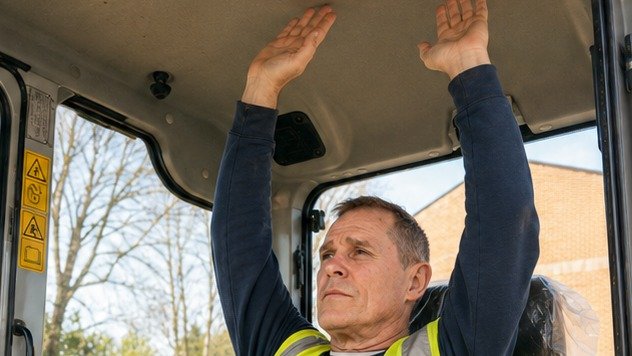
    Stand upright and clasp your hands behind your back, interlacing your fingers. Straighten your arms and gently lift them while opening your chest and squeezing your shoulder blades together. Hold for 20–30 seconds.

    If you can’t clasp your hands, just pull both arms back behind you as far as comfortable. You’ll still feel it.

    When to do it: Any time you’re standing and waiting. Takes 30 seconds.

    When to Fit These In

    You don’t need a dedicated stretching session. Just attach them to things you’re already doing:

    • Start of shift: Hip flexor stretch and chest opener while the machine warms up
    • Mid-morning break: Seated spinal twist and neck stretch in the cab
    • Lunch: Standing hamstring stretch while you’re out of the machine
    • End of shift: All five, takes under 10 minutes

    That’s it. You’re not being asked to do a workout on top of a full day’s graft. Just move a bit at the natural break points that already exist in your day.

    What Happens If You Don’t

    The stiffness you feel now doesn’t just stay the same – it builds. Tight hip flexors left unaddressed lead to lower back pain. Lower back pain that gets ignored becomes the kind of chronic issue that starts affecting your sleep, your mood, and eventually your ability to work.

    It’s not dramatic. It just compounds quietly, year after year, until one day you’re dealing with something that a physio or a doctor is telling you could have been prevented.

    And it’s not just the stretching – hydration plays a bigger role in back pain than most people realise. If your back pain is already more than just stiffness, this is worth a read: Why Your Back Pain Might Be a Hydration Problem.

    Why Your Legs Feel Heavy and Swollen After a Day in the Cab

    Need More Help?

    If you’re already past the stiffness stage – ongoing back pain, hips that won’t loosen up no matter what you do, or you want practical advice that accounts for what your job actually does to your body – I’m happy to help.

    Get in touch through the contact form.

    Stewart Axon has spent over 40 years split between construction sites and professional fitness training. He helps machine operators and men over 40 who want to stay strong, mobile and capable – without it taking over their life. He’s been on the tools, in the cab, and on site. He knows what real working life looks like.

    Related reading:
  • How to Get Fit After 40 When You’re Stiff and Out of Shape

    How to Get Fit After 40 When You’re Stiff and Out of Shape

    Feeling stiff, out of shape and not sure where to start? Here’s what actually works for men over 40 who want to get back in shape without wrecking themselves.

    Why Getting Fit After 40 Feels So Hard (And Why It’s Not Too Late)

    You remember being fitter. You moved easier, recovered quicker, and didn’t think twice about getting up off the floor. At some point, somewhere between the job, the family, and just getting on with life, that changed.

    Now you’re stiff in the morning. You’re carrying weight you didn’t used to carry. You get tired quicker than you should. And every time you think about doing something about it, the whole thing feels overwhelming, because the advice you find online seems to be written for someone half your age.

    I hear this all the time. And I want to be straightforward with you: it’s not too late, and it’s not as complicated as the fitness industry makes it look. But you do need to understand what’s actually happening in your body after 40, because it changes what you should be doing about it.

    What Actually Changes After 40

    There are real physiological changes that happen as you get older. None of them are catastrophic. But ignoring them is why a lot of men over 40 try to get back in shape and end up hurt, frustrated, or both.

    Muscle loss accelerates. From your mid-30s onwards, you lose muscle mass more quickly than you did when you were younger. This is called sarcopenia, and it’s one of the main reasons men over 40 feel weaker and more tired without doing anything obviously different. The good news is that strength training directly reverses it. Your body still responds, it just needs the right signal.

    Recovery takes longer. A 25-year-old can train hard, sleep badly, and bounce back. You can’t, and trying to work on that timeline is a fast route to injury. Rest and recovery aren’t optional extras, they’re part of the training.

    Testosterone drops gradually. Lower testosterone means it’s harder to build and hold onto muscle, and easier to accumulate fat around the middle. Again, not a death sentence. Strength training is one of the most effective natural ways to support healthy testosterone levels.

    Joints accumulate wear. Decades of work, sport, carrying loads, and just living take a toll on your joints. That stiffness you feel in the morning isn’t in your head, it’s your body taking longer to warm up than it used to. This means your warm-up matters more than it did at 25, and your training needs to support your joints rather than hammer them.

    None of this means you’re done. It means you need to train smarter than you did in your 20s, which, honestly, isn’t a high bar.

    The Biggest Mistake Men Over 40 Make When Getting Back in Shape

    Going too hard, too fast.

    I’ve seen it dozens of times. A man in his 40s or 50s decides enough is enough, walks into a gym, and starts training like he’s 22. Three weeks later his knees hurt, his back is giving him grief, and he’s convinced his body just can’t do it anymore.

    The body can do it. The problem was the approach.

    Your joints and connective tissue, tendons, ligaments, don’t adapt as quickly as your muscles do. Your muscles might feel fine after a hard session, but the tendons holding everything together haven’t caught up yet. That’s where injuries come from when you come back too aggressively after years off.

    The other mistake is jumping straight to high-intensity training, circuits, bootcamps, HIIT classes, because it feels like the fastest route to results. For a deconditioned body over 40, high intensity before you’ve built a foundation is like running before you can walk. It works for a while, right up until something breaks.

    Start slower than you think you need to. Build the foundation first. The results still come, and they stick around longer.

    How to Start Without Wrecking Yourself

    The first four weeks are about building a base, not making up for lost time.

    Start with three sessions a week. Not five. Not every day. Three, with rest between each one. Your body does its adapting during recovery, not during the session itself. Give it time to do that.

    Keep sessions to 30–40 minutes. A focused 30-minute session done three times a week will change your body. A sporadic two-hour session once a week won’t.

    Move before you train. Ten minutes of gentle movement before you do anything else, hips, shoulders, spine, makes a significant difference both to how you feel during the session and to your injury risk. Don’t skip it.

    Use effort levels you can sustain. If you’re breathless and can’t hold a conversation, you’re working too hard for this phase. You want to feel like you’ve worked, not like you’ve been through a blender.

    This isn’t a forever approach, it’s a starting approach. After four to six weeks of this, your body is ready for more, and you can push harder. But this is the foundation that makes everything else work.

    What to Focus On: Strength, Mobility, and Consistency

    These are the three things that actually move the needle for men over 40.

    Strength training. Not bodybuilding, functional strength. Squats, hinges, presses, rows. Movements that carry over into real life. This is what preserves muscle mass, supports your joints, keeps your metabolism working, and makes you feel capable again. It’s also the single most effective thing you can do for long-term health as you age.

    Mobility work. Stiffness is usually a mobility problem, not a damage problem. Regular, consistent mobility work, hips, thoracic spine, shoulders, is what stops you feeling locked up. Ten minutes a day, done consistently over weeks, will change how you move and how you feel more than most people expect.

    Consistency over intensity. This is the one that matters most. A moderate session done three times a week, every week, for three months, will deliver results that no amount of sporadic hard sessions can match. The body adapts to what it does repeatedly. Make showing up the habit, and the results follow.

    A Simple Starting Point

    If you want something to do this week, start here:

    • Monday: 30–40 minute full body strength session (3 sets of 5–6 exercises, moderate weight)
    • Wednesday: 20 minute mobility session (hips, spine, shoulders)
    • Friday: 30–40 minute full body strength session

    That’s it. Three sessions. Under two hours of total training across the whole week. Done consistently for six weeks, most men notice real changes, less stiffness in the morning, more energy, clothes fitting differently.

    It’s not complicated. The hard part is starting, and then not stopping when life gets in the way.

    Ready to Stop Guessing?

    The problem with trying to figure this out alone is that most of what’s out there wasn’t written for men in their 40s and 50s who’ve spent decades working hard and want a realistic route back to feeling good in their bodies.

    That’s exactly who Axon Fitness was built for.

    If you’d like help working out where to start, send me a message through the contact form and we’ll have a straightforward conversation about what you need. No sales pitch. No generic plan.

    Related reading: